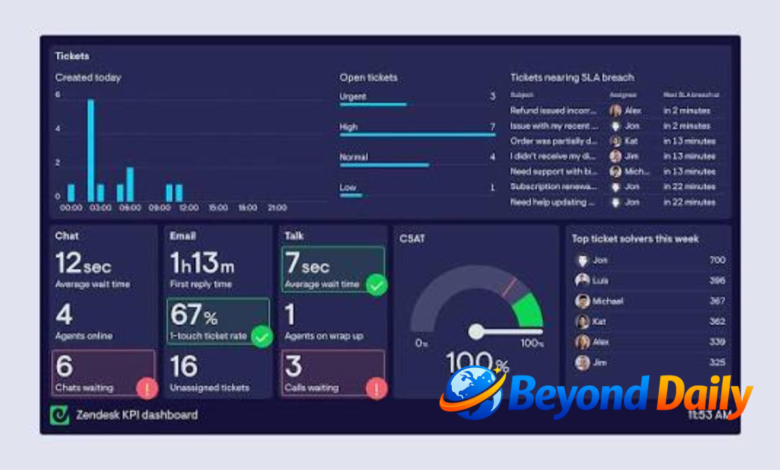
Key performance indicators give businesses a practical way to understand whether they are moving towards their goals. Rather than relying on assumptions, managers can use measurable information to assess revenue, profitability, customers, sales, marketing and operations. The right indicators can make complex business performance easier to understand and provide useful evidence for everyday decisions.
The most useful business KPI examples are linked directly to a company’s objectives. A growing company may focus on revenue growth and customer acquisition, while an established organisation may pay closer attention to profit margins, retention and cash flow. The important point is not to measure everything, but to identify the figures that genuinely help explain progress.
What Are Business KPI Examples?
A key performance indicator, or KPI, is a measurable value used to assess how effectively a business is progressing towards an important objective. KPIs can be financial or non-financial, depending on what a company needs to understand. For example, revenue and profit margin can show financial performance, while customer satisfaction can provide insight into the customer experience.
Business KPI examples therefore vary according to the area being measured. A sales team might monitor lead conversion, whereas an operations team could examine fulfilment time. Customer service teams may track satisfaction and resolution times. This variety allows companies to create a measurement system that reflects their own priorities instead of relying on a generic list of numbers.
Financial Business KPI Examples
Financial KPIs help businesses understand whether their commercial activity is producing sustainable financial results. Revenue growth measures how quickly sales are increasing over a particular period, while gross profit margin considers revenue against the cost of producing goods or services. Net profit margin goes further by showing the percentage of revenue remaining after costs have been accounted for.
Operating cash flow is another useful indicator because profitability alone does not necessarily show how much cash is being generated by normal business activity. Other measures, such as return on investment, can help organisations understand the financial return associated with particular spending or projects. The most useful financial indicators will depend on the company’s model, size, industry and objectives.
Sales and Marketing Business KPI Examples
Sales and marketing KPIs help companies understand how effectively they attract prospects and convert them into customers. Customer acquisition cost, commonly known as CAC, measures the money spent to acquire a new customer. Lead conversion rate looks at the proportion of potential leads that become paying customers, helping businesses assess the effectiveness of their sales process.
Customer lifetime value can provide another useful perspective by estimating the revenue generated by a customer over the relationship with the business. Monthly recurring revenue is particularly relevant to subscription-based organisations because it provides a view of predictable monthly income. Used together, these measures can provide more context than simply looking at the number of leads or sales generated.
Customer and Service KPIs to Monitor
Customer-focused indicators can reveal whether a business is meeting expectations after a sale has taken place. Customer satisfaction score, or CSAT, is commonly used to capture how satisfied customers are with a service or interaction. Customer churn measures the proportion of customers who stop doing business with a company during a defined period.
Average resolution time can also be valuable for organisations that provide customer support. It measures the typical time required to resolve a reported issue and can help teams identify service delays. Looking at satisfaction, retention and resolution together gives a broader picture of the customer journey and may make it easier to identify areas where service processes could be improved.
Operational and Employee KPI Examples
Operational KPIs focus on the efficiency and consistency of everyday business activities. Order fulfilment cycle time, for example, measures the time involved in moving an order through the fulfilment process. Shorter cycle times may indicate efficient processes, although the appropriate target depends on the nature of the business and customer expectations.
People-related measures can also form part of a KPI framework. Employee turnover rate shows how frequently workers leave an organisation, while absenteeism measures employee absence. These figures need careful interpretation because a single percentage rarely explains why a result has changed. Businesses should combine operational data with context before deciding what action is appropriate.
Small Business KPI Examples Worth Tracking
Small businesses do not necessarily need a complicated measurement system. A focused dashboard containing a handful of relevant indicators can provide useful visibility without creating unnecessary administrative work. Revenue, net profit, gross profit margin, cash flow, customer acquisition cost and customer satisfaction can be useful starting points, depending on the business model.
The right small business KPI examples should reflect the owner’s most important goals. A service company may need to monitor utilisation and repeat customers, while an online retailer could focus more closely on conversion, average order value and fulfilment. Starting with a small group of indicators makes it easier to understand what each number means and how it relates to business performance.
How to Choose the Right KPIs for Your Business
Choosing KPIs should begin with the outcomes a business wants to achieve. If the objective is to increase recurring revenue, an appropriate KPI should provide meaningful information about recurring income or the factors influencing it. If improving customer experience is the priority, customer satisfaction, retention and service response measures may be more relevant.
Each KPI should also have a clear definition, data source, reporting period and responsible owner. Businesses should establish how frequently the information will be reviewed and what constitutes meaningful movement. This structure helps prevent confusion and ensures that KPI reporting becomes part of normal business management rather than a collection of figures produced without a clear purpose.
How to Use KPIs to Improve Business Performance
Tracking a Business KPI Examples is only the beginning. The real value comes from examining what the figures reveal and deciding whether further investigation is needed. Comparing current performance with previous periods or established targets can highlight trends, changes and potential problems. A sudden decline in conversion, for example, could encourage a business to investigate its sales process, website or customer journey.
It is also useful to consider related measures together. A rise in sales may appear positive, but if customer acquisition costs have increased significantly at the same time, the wider picture may be different. Likewise, faster service resolution may need to be considered alongside customer satisfaction. Looking at connected indicators helps businesses avoid drawing conclusions from one isolated number.
Common KPI Mistakes Businesses Should Avoid
One common mistake is attempting to track too many indicators. A long dashboard can make important information harder to identify and may encourage teams to focus on reporting rather than improvement. Businesses should prioritise measures that have a clear relationship with their objectives and remove indicators that provide little practical value.
Another issue is using KPIs without consistent definitions. If different teams calculate the same measure differently, comparisons can become unreliable. Businesses should document how each KPI is calculated and maintain a consistent reporting process. Targets should also be reviewed periodically because business conditions, strategies and priorities can change over time.
Conclusion
The most useful business KPI examples provide a clear connection between business objectives and measurable performance. Financial measures can show profitability and cash generation, while sales, marketing, customer and operational indicators provide insight into other parts of the organisation. There is no universal KPI list that suits every company, so selection should always reflect the business model and its current priorities.
A practical approach is to begin with a focused set of meaningful indicators, define each one clearly and review the results consistently. As the business develops, its KPI framework can evolve with it. Used thoughtfully, KPIs can turn everyday business data into clearer information for planning, monitoring performance and making informed decisions.
Frequently Asked Questions
What are business KPI examples?
They include measures such as revenue growth, profit margin, customer acquisition cost, conversion rate, customer satisfaction and employee turnover.
What are the most important KPIs for a business?
The most relevant KPIs depend on the business, but financial, customer, sales and operational measures are common areas to monitor.
What are some small business KPI examples?
Small businesses may track revenue, profit margin, cash flow, customer acquisition cost, customer retention and satisfaction.
What are financial KPIs?
Financial KPIs measure areas such as revenue, profitability, cash flow, costs and investment performance.
What is a good KPI for sales?
Lead conversion rate, sales growth, customer acquisition cost and customer lifetime value can provide useful sales insights.
How many KPIs should a business track?
There is no universal number, but businesses generally benefit from focusing on a manageable set directly linked to their objectives.
How do you choose the right KPI?
Start with a specific business goal and select a measurable indicator that provides meaningful information about progress towards that goal.
What is the difference between a KPI and a metric?
A metric is a measurable business figure, while a KPI is a metric specifically selected because it helps monitor progress towards an important objective.
Also Read: business app