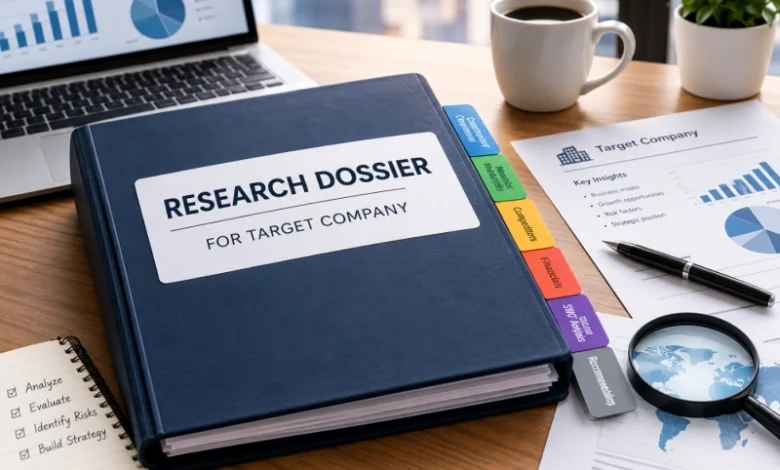
A research dossier for target company prep is a short, organized brief on one company: what it sells, how it makes money, who runs it, what’s changed recently, and what problems it’s likely dealing with. A good one fits on two or three pages and ends with the specific questions you plan to ask.
That last part is what separates a dossier from a pile of notes.
People build these before job interviews, sales calls, partnership pitches, investments, and acquisitions. The depth changes a lot between those uses. The basic method doesn’t.
What Is a Research Dossier for a Target Company?
Think of it as a briefing file. Military and intelligence teams have used dossiers for decades for one reason: a decision-maker walking into a room needs the right ten facts, not the available thousand.
The same idea applies to business. Picture a hiring manager asking, “So what do you know about us?” One candidate says the company is “a leader in logistics software.” Another says revenue grew 18% last year, the CEO flagged driver shortages as the top risk on the last earnings call, and three new data roles were posted this month. Which one sounds like they belong in the job?
The second candidate didn’t work harder. They organized better.
A dossier has three layers:
- Facts: what’s true and checkable (revenue, headcount, leadership, products).
- Signals: what recent changes suggest (new hires, layoffs, a price increase, a lawsuit).
- Implications: what it means for your conversation, and what you’ll ask about it.
Most guides stop at layer one. That’s why most dossiers never get used.
Who Needs One, and How Deep Should It Go?
The right depth depends entirely on what’s at stake. A two-hour dossier for a first-round interview is overkill. A two-hour one for a $5 million acquisition is negligent.
| Use case | Main goal | Typical length | Time to build |
|---|---|---|---|
| Job interview | Show fit, ask sharp questions | 1–2 pages | 60–90 minutes |
| Sales or account research | Find a real problem you can solve | 1 page per account | 20–45 minutes |
| Partnership or vendor pitch | Understand priorities and decision-makers | 2–3 pages | 2–4 hours |
| Investing (individual) | Judge business quality and risk | 3–5 pages | 4–10 hours |
| M&A or formal due diligence | Find deal-breakers and value | Dozens of pages, plus data room review | Weeks, with lawyers and accountants |
This guide focuses on the first three rows, where one person does the work alone. Formal due diligence is a different discipline with legal obligations, and it needs professionals.
What Should the Dossier Include?
Use the same skeleton every time. Consistency means you can compare companies side by side and spot gaps fast.
- Snapshot. Name, HQ, founding year, ownership (public, private, PE-backed), headcount, and revenue or best estimate. Five lines max.
- Business model. What they sell, to whom, and how they charge. Subscription? One-time sales? Ads? Commission? If you can’t explain it in two sentences, keep researching.
- Financial health. Revenue trend over three years, profitability, cash position, and any debt worth noticing. For private companies, use proxies like funding rounds and hiring pace.
- Leadership and decision-makers. CEO, relevant executives, and the people you’ll actually meet. Note tenure. A CFO who joined four months ago often means change is coming.
- Recent news (last 12 months). Launches, acquisitions, layoffs, lawsuits, leadership changes, big customer wins.
- Competitors. Three to five, with one line on how this company differs.
- Stated priorities. What leadership says matters, pulled from annual reports, earnings calls, and interviews.
- Pain points. What’s hard for them right now, with evidence.
- Your angle. Where you, your product, or your offer fits.
- Questions to ask. Five to eight, each tied to something in the sections above.
Section 10 is the payoff. If a question could be asked of any company, it doesn’t belong there.
Where Do You Find the Information?
Good news: the best sources are mostly free. The bad news is that private companies give you far less to work with.
Public companies
In the US, start with SEC EDGAR (sec.gov/edgar). It’s free and holds every filing a public company makes. Three documents do most of the work:
- Form 10-K (annual report): Read Item 1 (Business) and Item 1A (Risk Factors) first. Risk Factors is where the company lists, in its own words, what could hurt it. That’s a ready-made pain-point list.
- Form 10-Q (quarterly report): Shows the latest numbers between annual reports.
- Form 8-K: Filed for major events like executive departures, acquisitions, or material agreements. Scan the last year’s worth.
Then listen to the most recent earnings call. Most companies post the webcast on their investor relations page. The analyst Q&A near the end is gold, because analysts ask about exactly the problems management would rather not volunteer.
The proxy statement (DEF 14A) tells you how executives are paid. If the CEO’s bonus is tied to margin rather than growth, expect cost-cutting conversations.
Outside the US, look for the equivalent regulator or stock exchange filings. In the UK, Companies House is free and covers public and private companies alike.
Private companies and startups
This is where most people give up too early. You won’t get audited financials, but you can triangulate:
- Companies House (UK): Free filed accounts, directors, and “persons with significant control.” Even small UK companies file something, which beats what you’ll find for most US private firms.
- Crunchbase or PitchBook: Funding rounds, investors, and dates. A Series B 30 months ago with no follow-up round can mean the company is profitable, or running low on cash. Look for other signals to tell which.
- Job postings: The most underrated source. Twelve open sales roles and zero engineering roles tells you something different from the reverse.
- LinkedIn: Headcount trends, executive backgrounds, and recent hires. Look at who joined in the last six months and from where.
- Glassdoor and Indeed reviews: Read the last 20, not the overall star rating. Repeated mentions of “constant reorgs” or “great new VP” are real signals.
- The Wayback Machine (web.archive.org): Compare the homepage today with two years ago. Changes in pricing pages or positioning show where strategy shifted.
- Google News and trade press: Industry publications often cover mid-size private firms the big outlets ignore.
Set up a Google Alert for the company name the day you start. Free, two minutes, and it keeps the dossier current without effort.
How Do You Build One in 90 Minutes?
Here’s a time-boxed method for an interview or pitch. Use a timer. Without one, you’ll spend 50 minutes on the website and nothing on the questions.
- Minutes 0–10: Snapshot. Company website, LinkedIn page, and one funding or filing source. Fill in section 1.
- Minutes 10–30: Money and model. For public companies, skim the 10-K’s Business section and the income statement. For private ones, check funding history and pricing pages.
- Minutes 30–45: Last 12 months of news. Google News, the company’s press page, and any 8-Ks. Write one line per event.
- Minutes 45–60: People. Leadership bios plus the specific people you’ll meet. Note one thing each has said publicly, like a podcast quote or LinkedIn post.
- Minutes 60–75: Pain points and competitors. Risk Factors, earnings call Q&A, recent reviews, and job postings.
- Minutes 75–90: Your angle and questions. This is the most important 15 minutes. Don’t let it get squeezed.
Then stop. A 90-minute dossier you actually use beats a 6-hour one you skim in the parking lot.
What Does a Good Entry Actually Look Like?
Here’s the difference in practice, using a made-up mid-size software company for illustration.
Weak entry:
Acme Routing is a SaaS company that helps logistics firms. They are growing and recently hired new people.
Nothing wrong with it. Nothing useful in it either.
Strong entry:
Fact: Acme Routing raised a $40M Series C in March; LinkedIn headcount grew from 210 to 290 over the past year. Signal: 9 of 14 open roles are in customer success, and recent Glassdoor reviews mention onboarding backlogs. Implication: They’re signing customers faster than they can onboard them. Retention is probably the board’s worry. Question: “With the growth since the Series C, how are you thinking about keeping onboarding time down for new accounts?”
Same company, same 15 minutes of research. The second version gives you a conversation. Use that fact → signal → implication → question pattern for every important finding.
What Do Most People Get Wrong?
After reviewing a lot of these, the same mistakes come up again and again:
- Collecting instead of concluding. Pasting 12 news links isn’t research. If a fact doesn’t lead to an implication or a question, cut it.
- Stopping at the company website. The site is marketing. The 10-K, reviews, and job posts are where the honest picture lives.
- Using stale data. A three-year-old article about “rapid expansion” means little if the company had layoffs last spring. Put a date next to every fact.
- Ignoring the people. Companies don’t make decisions; individuals do. Knowing your interviewer spent eight years at a competitor changes how you talk.
- Showing off in the meeting. Reciting revenue figures at someone sounds rehearsed. Use the research to ask better questions, not to give a lecture.
- Skipping the “so what.” Most people can tell you what a company does. Few can tell you what it’s worried about this quarter.
That last one matters most. If your dossier doesn’t answer “what’s keeping them up at night?”, it isn’t finished.
Where Is the Line on Ethical Research?
Simple rule: use what’s publicly available, and never pretend to be someone you’re not to get information.
That means:
- Fine: Filings, press, public social posts, published reviews, job listings, conference talks, and your own network who are willing to chat.
- Not fine: Posing as a customer or job candidate to extract internal details (called pretexting), asking current employees to share confidential documents, or using leaked material.
- Be careful with personal data: Researching an executive’s professional background is normal. Compiling their home address or family details is not, and in the EU and UK, storing personal data carries obligations under GDPR.
If you’d be uncomfortable explaining how you learned something, don’t use it.
How Do You Keep It Useful After Day One?
A dossier built for one meeting tends to rot in a downloads folder. Treat it as a living document instead.
- Keep one file per company, with a “last updated” date at the top.
- Add a short log after every interaction: who you spoke to, what they said, what surprised you. After a second-round interview, this log is often more valuable than the original research.
- Review the Google Alert digest weekly and add anything that changes your implications.
- For sales teams, store it in the CRM account record, not someone’s laptop. When a rep leaves, the research shouldn’t leave with them.
A sales rep working 40 target accounts can refresh each one in 10 minutes a month. That’s under seven hours for the whole list, and it means every call starts from current information.
6. FAQ
What is a research dossier for a target company? It’s a concise brief that pulls together the key facts, recent changes, and likely challenges of one company, prepared before an important interaction like an interview, sales call, or deal. It usually ends with tailored questions. For most purposes, two or three pages is enough.
How long does it take to build a company dossier? For a job interview or sales pitch, 60 to 90 minutes is usually enough if you follow a set structure. Account research for prospecting can take as little as 20 minutes per company. Investment or acquisition research takes far longer and, for deals, involves professional advisors.
Where can I find financial information on a private company? Private US companies rarely publish financials, so you’ll rely on proxies: funding data from Crunchbase or PitchBook, headcount trends on LinkedIn, and hiring patterns in job postings. UK private companies file accounts with Companies House, which you can search free online.
What’s the most useful part of a 10-K for research? Item 1A, Risk Factors, is the most useful starting point because the company lists the threats it takes seriously. Pair it with Item 1 (Business) for the model and Item 7 (MD&A) for management’s explanation of the numbers. Together, they give you most of what you need in under an hour.
Is researching a company before an interview considered normal? Yes. Interviewers generally expect it, and failing to show basic knowledge of the company is a common reason candidates get marked down. The goal is to ask informed questions, not to recite facts.
What tools help organize a company dossier? A simple document or spreadsheet with a fixed template works for most people. Sales teams usually keep account research inside their CRM, such as Salesforce or HubSpot, so it stays with the account. Add a free Google Alert for each company to keep the information current.
7. Conclusion
You don’t need more information than other people; you need better conclusions from the same information. If you take one thing from this guide, end every research dossier for target company prep with three questions only you could ask, because you did the reading. Everything above exists to get you there.