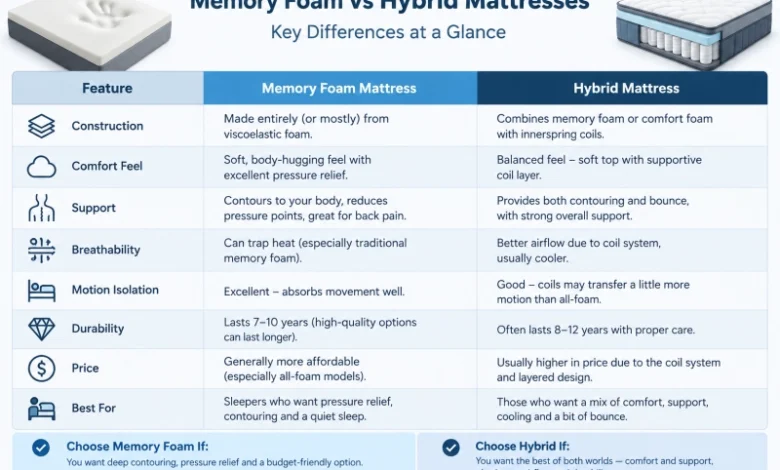
If you want to make a table comparing memory foam vs hybrid mattresses, the short version is this: memory foam wins on motion isolation, pressure relief, and price, while hybrids win on cooling, bounce, edge support, and durability for heavier sleepers. The full table is below, followed by a template for comparing the specific models on your shortlist.
That second part matters more than most guides admit.
A generic chart tells you how the two categories behave on average. But you’re not buying a category. You’re buying one mattress, from one brand, with one return policy. So this guide gives you both.
What’s the Real Difference Between Memory Foam and Hybrid?
It comes down to what’s holding you up.
A memory foam mattress is foam all the way through. The top layers are viscoelastic foam, the slow-sinking material first developed at NASA’s Ames Research Center in 1966. Underneath sits a dense polyfoam base, usually 6 to 8 inches thick, that does the actual supporting.
A hybrid mattress keeps foam (or latex) comfort layers on top but swaps the foam base for a layer of pocketed coils, individually wrapped springs that move on their own. Most queen hybrids have somewhere between 800 and 1,200 of them.
Here’s a simple way to picture it. Pressing your hand into memory foam is like pressing into cold cookie dough: it gives slowly and holds your shape for a second after you lift away. Pressing into a hybrid feels more like a firm trampoline with a thick pad on top. It pushes back.
One catch: plenty of “hybrids” use memory foam as their top layer. Those feel like a blend of both, which is why reading the layer breakdown beats trusting the label.
Memory Foam vs Hybrid: The Side-by-Side Table
Here’s the category-level comparison. Prices are typical U.S. ranges for a queen; retailer estimates vary, so treat them as ballparks.
| Factor | Memory Foam | Hybrid |
|---|---|---|
| Core support | High-density polyfoam base | Pocketed coils (usually 800–1,200 in a queen) |
| Feel | Slow sink, “hug,” body contouring | Bouncier, more on-top-of-the-bed |
| Pressure relief | Excellent, especially shoulders and hips | Good to excellent, depending on comfort layers |
| Motion isolation | Excellent; a partner’s movement barely registers | Good; pocketed coils help, but some bounce carries |
| Temperature | Tends to trap heat, even with gel infusions | Cooler, since air moves through the coil layer |
| Edge support | Weak; edges compress when you sit | Strong, especially with reinforced perimeter coils |
| Ease of moving / repositioning | Harder; you sink in | Easier; the surface responds faster |
| Typical queen price | Roughly $250–$2,000+ (mid-range around $700–$1,300) | Roughly $400–$2,500+ (mid-range around $1,000–$1,700) |
| Typical lifespan | About 6–9 years | About 8–12 years |
| Weight (queen) | Often 60–90 lb | Often 90–140 lb |
| Noise | Silent | Nearly silent; cheap coils can creak over time |
| Off-gassing smell | Common for 1–3 days after unboxing | Usually milder (less foam overall) |
| Adjustable base compatibility | Excellent | Usually fine, but check the manufacturer’s notes |
| Best for | Side sleepers, light to average weight, light-sleeper couples | Hot sleepers, back/stomach sleepers, heavier bodies, combo sleepers |
If you only read one row, read “Temperature.” It’s the most common reason people return a memory foam bed in the first month.
Which One Fits Your Body and Sleep Style?
The table gives you tendencies. Your body decides which tendencies matter.
- Side sleeper under about 230 lb: Memory foam or a soft hybrid with a thick foam top. Your shoulders and hips need room to sink, and foam does that well.
- Back sleeper: Either works. A medium-firm hybrid keeps your hips from dipping, which is the usual cause of morning lower-back ache.
- Stomach sleeper: Lean hybrid and firm. Deep-sinking foam lets your midsection sag, arching your spine.
- Over about 230 lb: Hybrid, almost always. Coils hold up better under concentrated weight, and you’ll get more years before a body impression forms.
- Under about 130 lb: Memory foam often feels better, because lighter bodies don’t sink far enough into firm hybrids to get pressure relief.
- Hot sleeper or night sweats: Hybrid. Gel-infused foam helps a little, but coils help more.
- Couple with one light sleeper: Memory foam. Picture one partner getting up at 5 a.m. for a shift; on foam, the other likely won’t notice.
- Combination sleeper (you toss and turn): Hybrid. Changing positions on dense memory foam can feel like climbing out of a hole.
Can’t decide? A hybrid with 2 to 3 inches of memory foam on top is the most common compromise, and for many couples it’s the right one.
What Do the Spec Sheets Actually Tell You?
Two mattresses with the same label can be completely different beds. Three numbers explain most of the gap.
Foam density
Density is measured in pounds per cubic foot (lb/ft³) and is the best single predictor of how long foam lasts.
- Memory foam: Under 3 lb is low density and softens fast. 4 to 5 lb is high density and holds shape for years.
- Polyfoam base layers: Look for at least 1.8 lb.
Many budget brands don’t publish density. That silence usually tells you what you need to know.
Coil count and gauge
Coil count matters up to a point. Above roughly 800 in a queen, more coils mostly mean marketing.
Gauge is more useful. It describes wire thickness, and lower numbers mean thicker, firmer wire. Many hybrids use around 13 to 15 gauge in the center and a thicker gauge around the edges for better edge support.
Firmness numbers
Most brands rate firmness on a 1–10 scale, with “medium-firm” landing around 6 to 7. These scales aren’t standardized, though. One company’s 6 can feel like another’s 8.
So use firmness ratings to compare models within one brand, and lean on trial periods to compare across brands.
How to Make a Table Comparing Memory Foam vs Hybrid Mattresses for Your Shortlist
Once you’ve narrowed the type, build your own small comparison of the actual models you’re considering. Two or three is ideal. More than five and you’ll stop reading the columns.
A spreadsheet works, but a sheet of paper is honestly fine.
The columns worth including
- Model and type (memory foam or hybrid)
- Queen price after the current discount (most online brands run near-permanent sales, so the sticker price is rarely real)
- Total height in inches
- Comfort layer materials and thickness
- Foam density (or “not listed”)
- Coil count and edge reinforcement (hybrids only)
- Firmness rating
- Trial length in nights
- Minimum break-in period before you can return it
- Return fee or pickup charge
- Warranty length and sag threshold (how deep an impression must be before it’s covered, often 1 to 1.5 inches)
- Your score after lying on it, if you can test it in a store
Columns 9 through 11 are where the surprises hide. A 365-night trial means less if you’re charged $150 to send the bed back.
A filled-in example
Here’s what a finished shortlist might look like. The models are illustrative, but the spread of specs is typical of what you’ll see.
| Mattress A | Mattress B | Mattress C | |
|---|---|---|---|
| Type | Memory foam | Hybrid (foam top) | Hybrid (latex top) |
| Queen price (on sale) | $699 | $1,199 | $1,549 |
| Height | 12 in | 13 in | 12 in |
| Memory foam density | 4 lb | 3.5 lb | n/a |
| Coils / edge support | n/a | 1,024 / reinforced | 850 / reinforced |
| Firmness (1–10) | 5.5 | 6.5 | 7 |
| Trial | 365 nights | 120 nights | 100 nights |
| Break-in required | 30 nights | 30 nights | 30 nights |
| Return fee | Free | $99 | Free |
| Warranty | Lifetime (prorated) | 10 years | 15 years |
Now look at it as a side sleeper who runs warm. Mattress A is the cheapest and has the best trial, but it’s all foam. Mattress B has slightly lower-density foam on top, which can wear faster. Mattress C costs the most but offers the coolest surface and longest full warranty.
There’s no single right answer here. The table just turns a vague feeling into a trade-off you can actually see.
How Do Trials, Warranties, and Cost per Year Change the Math?
Sticker price is the wrong number to compare. Cost per year of good sleep is better.
Take two queens:
- Memory foam at $800, lasting about 7 years: roughly $114 per year
- Hybrid at $1,500, lasting about 10 years: roughly $150 per year
The gap is about $36 a year, or around 10 cents a night. If the hybrid stops you waking up sweaty at 3 a.m., that’s cheap. If you sleep cool and alone, the foam bed is the smarter buy.
A few practical rules for trials and warranties:
- Give any new mattress at least 30 nights. Your body needs time to adjust, and most brands won’t take a return before then anyway.
- Keep the receipt and photos of the law tag. Warranty claims often get denied without them.
- Use the right base. Many warranties require a solid platform or slats no more than about 3 inches apart. Old box springs can void coverage.
- Rotate head-to-foot every 3 to 6 months for the first year. It slows body impressions on both types.
What Do Most Buyers Get Wrong?
Trusting the category instead of the build. A $1,400 memory foam bed with 5 lb foam can outlast a $600 hybrid with thin, low-density layers. Type matters less than materials.
Overvaluing coil counts. A 2,000-coil mattress is not twice as supportive as a 1,000-coil one. Past around 800, gauge and edge reinforcement tell you more.
Judging from one night. Hotel beds, a friend’s guest room, a five-minute showroom test: none of these predicts how you’ll feel on night 20. That’s what trials are for.
Forgetting the weight. A 120 lb queen hybrid delivered in a box still has to go up your stairs. If you live on a third floor without an elevator, that’s worth a thought, or a check of whether white-glove delivery is included.
Ignoring the base. Putting a new mattress on a sagging old frame makes any bed feel bad. Many “this mattress is too soft” complaints are really “my base is broken” problems.
So what actually works? Pick the type that fits your body, compare three models on paper, then let the trial period make the final call.
6. FAQ
Is memory foam or hybrid better for back pain? For most people with back pain, a medium-firm hybrid is the safer starting point, because it keeps the hips from sinking too far. Side sleepers with shoulder or hip pain often do better on memory foam. Either way, choose medium-firm over very soft, and see a doctor if pain persists.
Do hybrid mattresses last longer than memory foam? Usually, yes. Typical estimates put quality hybrids at about 8 to 12 years and memory foam at about 6 to 9. A memory foam bed with high-density (4–5 lb) foam can close that gap, while a cheap hybrid with thin layers may not reach the top of its range.
Which sleeps cooler, memory foam or hybrid? Hybrids sleep cooler for most people. The coil layer lets air circulate, while dense foam holds body heat. Gel or copper infusions in memory foam help somewhat, but rarely match a hybrid.
Are hybrid mattresses worth the extra money? They’re worth it if you sleep hot, weigh over about 230 lb, sleep on your stomach, or often sit on the edge of the bed. If you’re a lighter side sleeper who sleeps cool, a well-built memory foam mattress often gives you the same comfort for several hundred dollars less.
How do I compare two mattresses online? List each model’s discounted price, layer materials, foam density, firmness rating, trial length, return fees, and warranty terms side by side in a simple table. Pay closest attention to return costs and break-in periods. Then use the trial to decide, since firmness scales aren’t standardized between brands.
Can I put a hybrid mattress on an adjustable base? Most modern hybrids work on adjustable bases, but not all. Check the manufacturer’s compatibility notes before buying. Memory foam mattresses are almost always compatible because they bend easily.
7. Conclusion
The category comparison gets you halfway there. The other half is putting your two or three actual options in one simple table, with return fees and warranty terms included, and then trusting the trial period over any spec sheet. If you do only one thing, check the “Temperature” row against how you sleep: it’s the fastest way to know which type to start with.