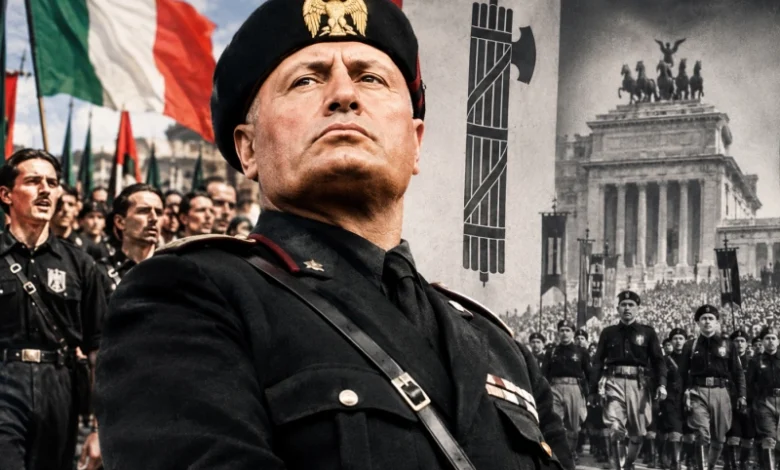
The fascisterne were the militant followers of interwar Italian fascism who used street violence and institutional pressure to overthrow a constitutional monarchy. Benito Mussolini organized the original combat squads in Milan in March 1919, turning disgruntled war veterans into a private army funded by nervous landowners.
History textbooks love to treat the rise of authoritarian regimes as a sudden earthquake.
It was actually a slow, transactional bleed. King Victor Emmanuel III handed over the prime ministership in October 1922 not because parliament fell in a military coup, traditional politicians invited him in as a junior coalition partner.
Here is the thing about the early squads. They did not march on Rome as a conquering horde; most arrived comfortably in sleeper train cars after the deal was already signed.
Who Are the Fascisterne in European History?
The term translates directly from Danish and Scandinavian historical lexicons as “the fascists,” pointing straight at Mussolini’s blackshirt militias. These men wore distinctive black shirts repurposed from paramilitary assault units, carrying wooden cudgels and castor oil bottles.
Forcing political opponents to swallow large doses of castor oil was a signature humiliation tactic. It caused severe dehydration and public disgrace, neutralizing local socialist mayors without firing a single execution squad bullet.
By 1921, the movement counted roughly 320,000 enrolled members across provincial Italy.
They operated with open police sympathy. Prefects in Emilia-Romagna frequently looked the other way when squadristi burned down cooperative farm headquarters.
How Did the Movement Rise From Milan Squares to National Power?
Electoral politics failed to stop them because the movement played a double game. Mussolini ran candidates on respectable national lists in 1921 while his local bosses terrorized rural ballot boxes.
Consider the October 1922 takeover timeline:
- October 24: Fascist delegates gather in Naples to plan regional mobilization.
- October 27: Squads seize telegraph offices and railway stations across northern towns.
- October 28: Columns converge on the outskirts of Rome in muddy, disorganized rain.
- October 30: The King refuses martial law and swears in Mussolini as premier.
The traditional liberal cabinet thought they could tame the street fighters through cabinet portfolios. Finance Minister Alberto de Stefani kept orthodox business policies for three years, reassuring corporate boards while the police state built its legal foundation.
What Core Tactics Did the Fascisterne Use to Control Society?
Totalitarian control requires breaking voluntary associations first. The regime banned independent trade unions in January 1926 through the Vidoni Palace Pact, replacing them with state-run syndicates.
Every citizen faced mandatory alignment through leisure and youth groups. The Opera Nazionale Balilla enrolled boys at age eight, trading schoolyard soccer for wooden rifle drills and ideological catechism.
Censorship operated through economic strangulation rather than simple blue-pencil edits. Newspaper owners who criticized party policy suddenly found newsprint quotas withheld or delivery trucks intercepted by local party enforcers. https://beyonddaily.co.uk/
By 1928, opposition parties held zero seats after the Acerbo Law rigged parliamentary math. A party winning just 25 percent of the national vote automatically grabbed two-thirds of the legislative seats.
Why Do Modern Debates Confuse Historical Fascism with General Authoritarianism?
Social media discourse applies the root term to almost any heavy-handed government mandate or police action. This cheapens the word and hides how actual 1920s radicalism functioned.
Standard authoritarian regimes want passive, depoliticized subjects who stay home and watch television. Fascism wanted hyper-mobilized citizens marching in squares on Sunday mornings, screaming loyalty oaths until hoarse.
Compare a bureaucratic military junta in 1970s Latin America with Mussolini’s Rome:
- The Junta: Ruled by a committee of generals, kept commercial life routine, banned politics completely.
- The Blackshirts: Ruled by a charismatic party boss, militarized youth culture, demanded public religious-like devotion to the state.
Calling a modern traffic fine or corporate HR policy “fascist” misses the defining ingredient. Mass voluntary terror backed by state impunity is a specific historical machine, not a generic adjective for rules you dislike.
What Can 1920s Politics Teach Us About Institutional Weakness Today?
Democratic guardrails fail when establishment elites believe radicals make useful anti-communist watchdogs. Conservative landowners in the Po Valley financed blackshirt trucks in 1920 to break agricultural strikes.
They assumed they could fire the hired muscle once the harvest was safe.
Instead, the muscle took over the boardroom. Industrial giants like Pirelli and Fiat kept production humming through the 1930s, trading labor peace for massive state rearmament contracts.
Look at contemporary governance structures under stress. Independent judiciaries and civil service boards erode from quiet, legal compliance rather than dramatic midnight raids. A judge who signs off on emergency decrees to “restore order” usually signs away the next ten years of judicial independence.
FAQ Section
What is the literal origin of the word behind fascisterne?
The word derives from the Latin fasces, a bundled wooden rod wrapped around an axe blade used by ancient Roman magistrates. It symbolized collective unity and supreme state authority over life and limb.
Did Benito Mussolini invent the blackshirt uniform?
No, the black shirts originated with Arditi assault troops from the First World War trenches. Mussolini adopted the military surplus aesthetic to project violent romantic heroism.
How did the movement treat existing laws and the constitution?
They kept the 1848 Albertine Statute formally intact while hollowing it out from within. Emergency decrees and packed courts legalized party violence retroactively.
Why did Italian conservatives support the initial takeover?
Factory owners and landowners feared a Bolshevik-style proletarian revolution after the 1919–1920 Red Two Years. They viewed the militia squads as a temporary private police force.
What separated Italian fascism from German national socialism?
Italian fascism prioritized total state supremacy over biological racism until alliance pressures shifted policy in 1938. German nazism placed racial purity and biological destiny at the center of state survival from day one.
Is the term interchangeable with modern far-right politics?
No, because historical fascism required a specific mass-party paramilitary structure and economic corporatism. Most contemporary radical movements lack organized labor syndicates and state-directed economies.