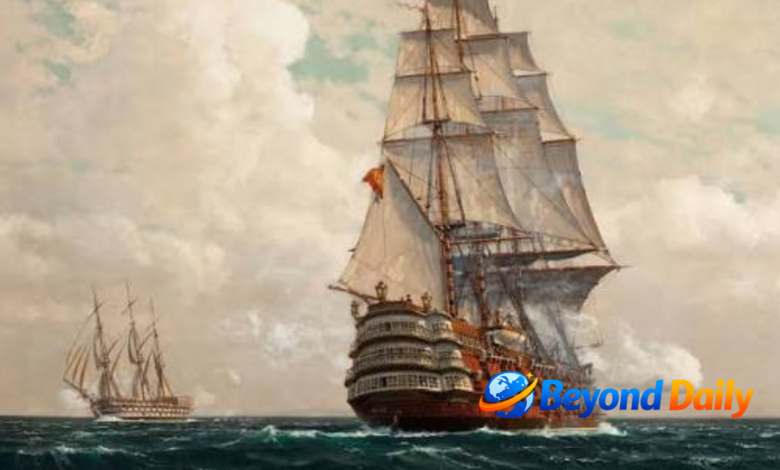
A man of war ship was a heavily armed sailing vessel designed primarily for naval combat during the great age of sail. These impressive ships carried powerful cannons, large crews and sophisticated rigging, allowing them to operate across oceans for extended periods. Although the phrase sounds like the name of one particular vessel, it was actually a broad historical term used for various military ships serving European naval powers.
From the sixteenth century onwards, the development of these warships transformed maritime warfare. Britain, Spain, Portugal and other European powers relied on increasingly capable vessels to defend trade routes, fight rival fleets and project influence overseas. Their huge wooden hulls, towering masts and rows of artillery made them some of the most recognisable symbols of naval power during the Age of Sail.
What Is a Man of War Ship?
The term man of war ship traditionally described an armed vessel belonging to a navy and intended for military operations. It was not necessarily a single technical class of vessel, because its meaning could change depending on the period and country involved. Large ships of the line were commonly regarded as men-of-war, while frigates and other armed naval vessels could also be described using the same general expression.
Unlike merchant ships, which were designed to transport goods and passengers, these vessels were built around combat requirements. Their hulls had to withstand enemy fire, while their gun decks needed to provide enough space for artillery and trained crews. Strong construction, manoeuvrability, sailing performance and firepower were therefore essential characteristics of an effective naval warship.
History of the Man of War Ship
The development of heavily armed sailing warships was closely connected to the growth of European maritime power. Earlier vessels such as galleons combined cargo-carrying ability with significant armament, but naval designers gradually began creating ships specifically for combat. Improvements in hull construction, sailing rigs and cannon technology allowed warships to become stronger, faster and more effective.
During the seventeenth and eighteenth centuries, naval warfare became increasingly organised around large fleets and carefully planned formations. Ships of the line became particularly important because they could carry numerous guns and fight effectively in coordinated formations. By the nineteenth century, however, steam propulsion and improved naval technology began changing warfare, eventually bringing the traditional era of wooden sailing warships towards its end.
British and English Man of War Ships
The British man of war ship became one of the most powerful symbols of Britain’s expanding naval strength. British warships protected commercial routes, defended overseas interests and participated in major conflicts around the world. Their success depended on a combination of advanced shipbuilding, strong naval organisation, experienced commanders and disciplined crews who could operate complex vessels under demanding conditions.
The expression English man of war ship generally relates to earlier periods of English naval history, particularly before the political creation of Great Britain. Over time, English naval traditions contributed to the development of the Royal Navy. Famous ships such as HMS Victory later demonstrated the immense power of the ship-of-the-line concept and became closely associated with Britain’s maritime heritage.
Spanish and Portuguese Man of War Ships
Spanish naval power was strongly connected with the use of large and well-armed sailing vessels. Spanish galleons became particularly important because they could combine substantial weaponry with the capacity to carry valuable cargo over long distances. They supported Spain’s extensive overseas interests and helped protect maritime routes during a period of intense competition between European powers.
Portuguese warships also played an important role in early European maritime expansion. Portuguese vessels supported exploration, commerce and military operations along routes connecting Europe with Africa, Asia and the Americas. It is important, however, to distinguish a historical Portuguese warship from the Portuguese man o’ war, which is a marine organism rather than a ship and has no connection with naval warfare.
Parts and Design of a Man of War Ship
The design of these vessels reflected the demanding conditions of naval combat. A typical large warship contained a strong wooden hull, multiple decks, several masts, yards, sails and extensive rigging. Gun ports were positioned along the sides, allowing artillery crews to fire broadsides. The bow, stern, quarterdeck and lower decks each had particular structural or operational purposes.
The parts of a man of war ship could vary depending on its size and period, but the basic principles remained focused on strength, stability and effective sailing. A man of war ship diagram can help readers understand these features by showing the relationship between the hull, masts, decks, gun positions and rigging. Visual diagrams are especially useful when explaining unfamiliar nautical terminology.
Weapons and Firepower
Cannons were the defining weapons of many major sailing warships. Large vessels could carry substantial batteries of artillery arranged along their gun decks. Instead of relying on a single forward-facing weapon, these ships could unleash powerful broadsides against enemy vessels. The number, size and positioning of guns depended on the vessel’s class, construction and intended military role.
Firepower alone did not guarantee victory. Gun crews required extensive training to load, aim and fire their weapons efficiently, often while the vessel was moving through rough seas. Sailors also had to control the sails and rigging while officers coordinated the battle. Damage to masts, steering equipment or gun decks could quickly reduce a vessel’s ability to fight effectively.
Man of War Ship Size and Crew
Man of war ship size varied significantly throughout history, meaning there was no single measurement that represented every vessel. Smaller armed ships could prioritise speed and manoeuvrability, whereas huge ships of the line were designed to carry several gun decks and enormous crews. Length, beam, draught, displacement and armament were all important factors when evaluating a warship’s overall scale.
Crew size also depended on the vessel’s dimensions and purpose. A large warship could require hundreds of people, including officers, sailors, marines, carpenters, cooks, surgeons and other specialists. Maintaining such a vessel was a major logistical undertaking. Food, water, ammunition, sails, timber and other supplies all had to be stored carefully for long voyages far from friendly ports.
The Largest Man of War Ship
Determining the largest man of war ship is surprisingly complicated because the word “largest” can have several meanings. Historians may compare ships according to length, displacement, number of guns, deck arrangement or crew size. A vessel that was longest was not necessarily the heaviest, while another might carry more artillery without being physically larger.
The biggest ships of the line were enormous wooden structures that required huge quantities of timber and skilled labour. Their size offered considerable advantages in firepower and endurance, but it also created challenges. Large crews were expensive to maintain, deep draughts limited access to some waters, and manoeuvring such vessels demanded considerable skill from their captains and sailors.
Famous Man of War Ships
Several famous warships provide useful examples of how naval technology developed. HMS Victory is perhaps the best-known British example, particularly because of its association with Admiral Horatio Nelson and the Battle of Trafalgar. The ship demonstrated the enormous firepower and operational complexity possible within a highly developed ship-of-the-line design.
The Centurion man of war ship is another important historical example. HMS Centurion served during the eighteenth century and became notable through Britain’s naval activities during that period. Examining individual vessels such as Centurion helps reveal how warships were adapted for particular missions and how naval strategy, shipbuilding and crew organisation evolved over time.
Life Aboard a Man of War Ship
Life aboard a large sailing warship was physically demanding and often uncomfortable. Sailors worked with ropes, sails, anchors and heavy equipment in all kinds of weather. Accommodation was usually cramped, while food and fresh water could become limited during lengthy voyages. Strict routines were necessary because even small mistakes could create serious risks aboard a large wooden vessel.
The crew included people with very different responsibilities. Officers managed navigation and command, sailors handled the ship’s movement, marines could support combat operations, and specialists such as surgeons and carpenters dealt with essential practical needs. Disease, accidents, storms and combat were constant dangers, making naval service one of the most demanding occupations of the period.
Man of War Ships in Naval Battles
Men-of-war played a central role in major naval battles during the Age of Sail. Large fleets often arranged their vessels into lines so that ships could deliver coordinated broadsides while maintaining an organised formation. Commanders had to consider wind direction, positioning, visibility and the movements of enemy vessels before committing their ships to an attack.
Naval combat required much more than simply firing cannons. Crews had to manage sails, repair damage and maintain their positions while under enemy fire. A damaged mast could reduce speed, while a destroyed rudder could make steering almost impossible. Successful commanders therefore combined tactical planning, seamanship and disciplined crew coordination to gain an advantage.
Man of War Ships in Popular Culture
The dramatic appearance of these historic vessels has kept them popular long after their military use disappeared. Tall masts, billowing sails, wooden hulls and rows of cannons frequently appear in films, paintings, games and historical illustrations. Their distinctive design captures the imagination because it represents a period when wind, wood, navigation and human skill determined naval power.
This popularity can also be seen in searches for man of war ship pictures, man of war ship wallpaper and man of war ship tattoo designs. Artists often use sailing ships to represent adventure, exploration, courage or freedom. While modern artwork can be highly imaginative, historically accurate illustrations can also help people understand the construction and appearance of these remarkable vessels.
Man of War Ships in Sea of Thieves

Interest in the phrase man of war ship Sea of Thieves shows how strongly Age-of-Sail imagery continues to influence modern entertainment. Games often use historical ship types, nautical terminology and naval combat as the foundation for immersive adventures. However, fictional vessels should not always be treated as exact historical recreations because gameplay frequently simplifies real sailing and combat.
Historical warships were considerably more complicated to operate than their digital counterparts. A large crew could spend hours managing sails, ropes, guns and navigation. Communication between different sections of the ship was essential, particularly during combat. Modern games capture the excitement of naval warfare but generally streamline these demanding tasks to create a more accessible experience.
Man of War Ship vs Ship of the Line
A ship of the line was a specific category of major sailing warship designed to fight in the line of battle. The broader expression man-of-war could refer to many armed naval vessels, including ships of the line. This means that the terms are closely connected but should not automatically be treated as exact synonyms in every historical context.
The distinction becomes particularly useful when researching naval history across different centuries. A smaller frigate might be called a man-of-war because it served a military role, while a powerful three-decker could be identified specifically as a ship of the line. Understanding the period and context helps prevent confusion when comparing different classes and descriptions.
Are Man of War Ships Still Used Today?
Traditional wooden sailing warships are no longer used as frontline naval combat vessels. The arrival of steam engines transformed naval operations by reducing dependence on wind, while iron and steel construction produced stronger and more durable hulls. Later developments introduced increasingly sophisticated guns, engines, sensors, aircraft and guided weapons, completely changing the nature of naval warfare.
Despite their disappearance from modern fleets, these historic vessels remain culturally and historically important. Preserved ships, replicas, museums and maritime collections allow visitors to explore the technology and working conditions of the Age of Sail. Their legacy can also be found in books, films, games and artwork, ensuring that the story of the great sailing warships continues to attract new audiences.
Conclusion
The man of war ship represents an important chapter in the history of naval warfare. These vessels combined powerful artillery, complex sailing systems, strong wooden construction and highly organised crews to become formidable instruments of maritime power. British, English, Spanish and Portuguese naval traditions all contributed to the wider development of armed sailing vessels during Europe’s long Age of Sail.
Although steam, steel and modern technology eventually replaced traditional sailing warships, their influence has not disappeared. Historic examples continue to inspire researchers, artists, museums and enthusiasts around the world. Understanding their design, weapons, crews and battles provides a fascinating glimpse into an era when controlling the seas depended on wind, craftsmanship, navigation and extraordinary human endurance.
Frequently Asked Questions
What is a man of war ship?
A man-of-war was a broad historical term for an armed naval vessel used for military purposes, particularly during the Age of Sail. It did not necessarily identify one specific ship class.
How big was a man of war ship?
The size varied considerably depending on the vessel’s type, period and purpose. Large ships of the line could have multiple decks, extensive artillery and crews numbering several hundred people.
How many crew members did a man of war ship have?
Crew numbers varied by vessel, but larger warships could require several hundred officers, sailors, marines and specialists to operate the ship, maintain equipment and handle its artillery.
What weapons did a man of war ship carry?
Major sailing warships primarily carried naval cannons arranged along their gun decks. Crews could also use smaller firearms and boarding weapons during close-range fighting.
What was the largest man of war ship?
There is no single universally accepted answer because “largest” can refer to length, displacement, armament or crew. Some of the biggest ships of the line were exceptionally large sailing warships.
Is a Portuguese man of war a ship?
No. The Portuguese man o’ war is a marine organism, not a historical warship. Its name resembles the term used for sailing warships, which can sometimes cause confusion between the two subjects.
What is the difference between a man-of-war and a ship of the line?
A man-of-war was a broad term for an armed naval vessel, whereas a ship of the line was a particular type of powerful warship designed to fight within a line-of-battle formation.
Are man of war ships still used today?
Traditional wooden sailing men-of-war are no longer used for frontline naval combat. Modern warships use engines, steel hulls, advanced sensors and sophisticated weapons instead.
Also Read: barnsley stadium