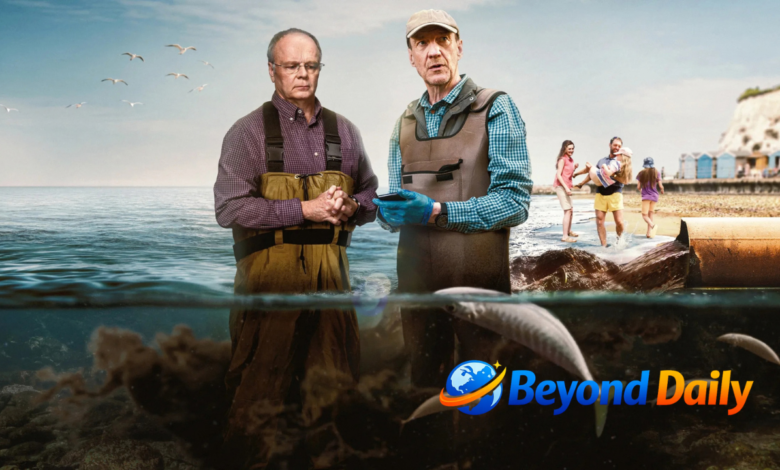
Channel 4’s Dirty Business Review is a three-part factual drama centred on Britain’s water pollution crisis and the people who investigate what is happening to rivers and coastal waters. The series combines dramatised events with real-world material, following characters inspired by people involved in investigations into sewage pollution. Channel 4 describes the programme as being based on a decade-long investigation into England’s water companies.
The programme attracted attention because it takes a complicated environmental and regulatory story and turns it into a character-led television drama. Rather than relying solely on statistics, it places ordinary people at the centre of the investigation. That approach gives viewers a personal route into questions about pollution, accountability, regulation and the condition of Britain’s waterways.
What Is Dirty Business About?
At the heart of Dirty Business are two retired neighbours who become concerned after noticing that fish are dying in the River Windrush in Oxfordshire. Ashley Smith and Peter Hammond begin asking questions about the condition of their local river, only to discover that the answers they receive raise further questions. Their investigation gradually develops from a local concern into something much wider.
The story also follows other real-life experiences connected with polluted water. One storyline concerns the Preen family and the death of eight-year-old Heather after she became seriously ill following exposure to contaminated water. The series uses these individual experiences alongside the wider investigation, showing how an environmental issue can affect people in deeply personal ways.
The Real Story Behind the Drama
One of the defining features of Dirty Business is its foundation in documented real events. The programme does not present itself as a conventional fictional thriller invented from scratch; instead, it dramatises a decade-long investigation and the experiences of whistleblowers and people affected by sewage pollution. This factual foundation gives the story a different kind of tension because viewers know that the subject matter has roots outside television.
The central investigation is particularly effective as a storytelling device because it begins with something relatively simple: two people want to understand why their local river appears to be deteriorating. As they collect information and examine patterns, the story expands towards broader questions about infrastructure, regulation and the water industry. The Guardian’s review similarly highlights the way the drama moves from local observations towards a much larger national picture.
Cast and Performances
David Thewlis leads the cast as Ashley Smith, while Jason Watkins plays Peter Hammond. Their characters provide the main investigative thread, but they approach the problem from different backgrounds and personalities. The contrast between them helps prevent the story from becoming a dry presentation of environmental information, giving the investigation a human rhythm and allowing moments of humour to sit alongside much more serious material.
The wider cast includes Posy Sterling and Tom McKay in the storyline involving the Preen family, while Asim Chaudhry is also among the principal cast members. The performances are important because the subject matter could easily become dominated by technical language and statistics. Instead, the actors give the audience people to follow, making the consequences of pollution easier to understand on an emotional and human level.
The Themes That Make the Series Powerful
A major theme running through Dirty Business is accountability. The drama asks what happens when ordinary people notice a serious problem and begin trying to establish exactly what is causing it. The investigation raises questions about who has responsibility for environmental damage, how information is handled and how effectively regulators can respond when problems become widespread.
Another important theme is the difference between data and lived experience. Water pollution can sound abstract when discussed through figures, reports and regulatory language, but the programme repeatedly brings the subject back to rivers, beaches, families and communities. That contrast makes the environmental issue more immediate without requiring viewers to have specialist knowledge of the water industry.
Dirty Business Review: What Works and What Divides Opinion
A significant strength of Dirty Business is its decision to combine factual material with conventional dramatic storytelling. The Guardian described it as a drama-documentary based on real-life events, while the Financial Times characterised it as a Channel 4 mini-series dealing with pollution caused by sewage spills. These descriptions underline the unusual position the programme occupies between traditional documentary and scripted drama.
The tone also shifts considerably. Some scenes involving Ash and Peter contain humour and lighter exchanges, while other parts are much darker and emotionally difficult. The Guardian noted this contrast, particularly between the investigation involving the two neighbours and the devastating story of the Preen family. That mixture gives the series a broader emotional range than a straightforward factual investigation might have.
Channel 4’s Approach to a Serious Subject
Channel 4 uses reconstruction, performances and real footage to build the programme’s picture of water pollution. This approach allows the audience to move between personal stories and wider evidence without relying on one storytelling method throughout. Real footage of affected waterways adds another layer of authenticity, while the dramatised scenes give structure to events that might otherwise be difficult to present in chronological form.
The result is a programme designed to make a complicated public issue accessible to a general television audience. Rather than turning the subject into a technical lesson, the series follows people who investigate what they see around them. That makes the central questions easier to follow while still leaving room for viewers to consider the evidence, the competing explanations and the wider environmental context.
Why the Series Matters to UK Viewers

The subject of Dirty Business review is particularly relevant in Britain because rivers, beaches and sewage infrastructure are part of everyday public life. The series takes an issue that can often appear in news reports as statistics or political arguments and places it into recognisable settings. Rivers, seaside holidays, local communities and recreational water use all become part of the story.
The programme also demonstrates how environmental problems can be investigated from the ground up. The two central characters do not begin as television investigators with unlimited resources. Their work develops from curiosity and persistence, eventually bringing them into contact with a much larger network of information and institutions. That progression is one of the reasons the factual material works effectively within a dramatic structure.
Final Thoughts on Dirty Business
Dirty Business offers a fact-based television story about water pollution through the experiences of investigators, families and people connected to the water industry. Its combination of dramatisation and real material gives the subject a strong sense of immediacy, while the central performances provide an accessible route into a complicated national issue. Channel 4 identifies the programme as a major factual drama based on a decade-long investigation.
For viewers interested in British factual drama, environmental issues or real-life investigations, the series provides plenty to consider. Its story moves between personal tragedy, investigative work and questions about regulation, making it broader than a conventional television mystery. Ultimately, the value of Dirty Business lies in how it connects the details of individual experiences with the wider story of Britain’s troubled relationship with water pollution.
Conclusion
Dirty Business offers a compelling look at Britain’s water pollution crisis by combining real events, personal stories and dramatic storytelling. Channel 4’s factual drama explores how concerns about polluted waterways can lead to wider questions about accountability, regulation and the water industry. With strong performances and a serious subject at its centre, the series gives viewers an accessible way to understand an issue that continues to affect communities across the UK.
Frequently Asked Questions
What is Dirty Business on Channel 4 about?
It is a three-part factual drama about water pollution and an investigation into sewage contamination in British waterways.
Is Dirty Business based on a true story?
Yes, Channel 4 says the series is based on a decade-long investigation and real stories involving water pollution.
How many episodes of Dirty Business are there?
Dirty Business consists of three episodes.
Who stars in Dirty Business?
David Thewlis, Jason Watkins, Posy Sterling and Asim Chaudhry are among the principal cast.
Is Dirty Business a documentary or drama?
It is presented by Channel 4 as a factual drama, combining dramatised storytelling with real-world material.
What real-life events inspired Dirty Business?
The programme draws on investigations into sewage pollution, including the experiences of campaigners and families affected by polluted water.
Where can I watch Dirty Business in the UK?
Dirty Business was broadcast by Channel 4, with availability through its television and streaming services subject to current scheduling.
What is the main issue explored in Dirty Business?
The series examines sewage pollution and the wider questions surrounding water companies, environmental regulation and public accountability.
Also Read: business casual shoes